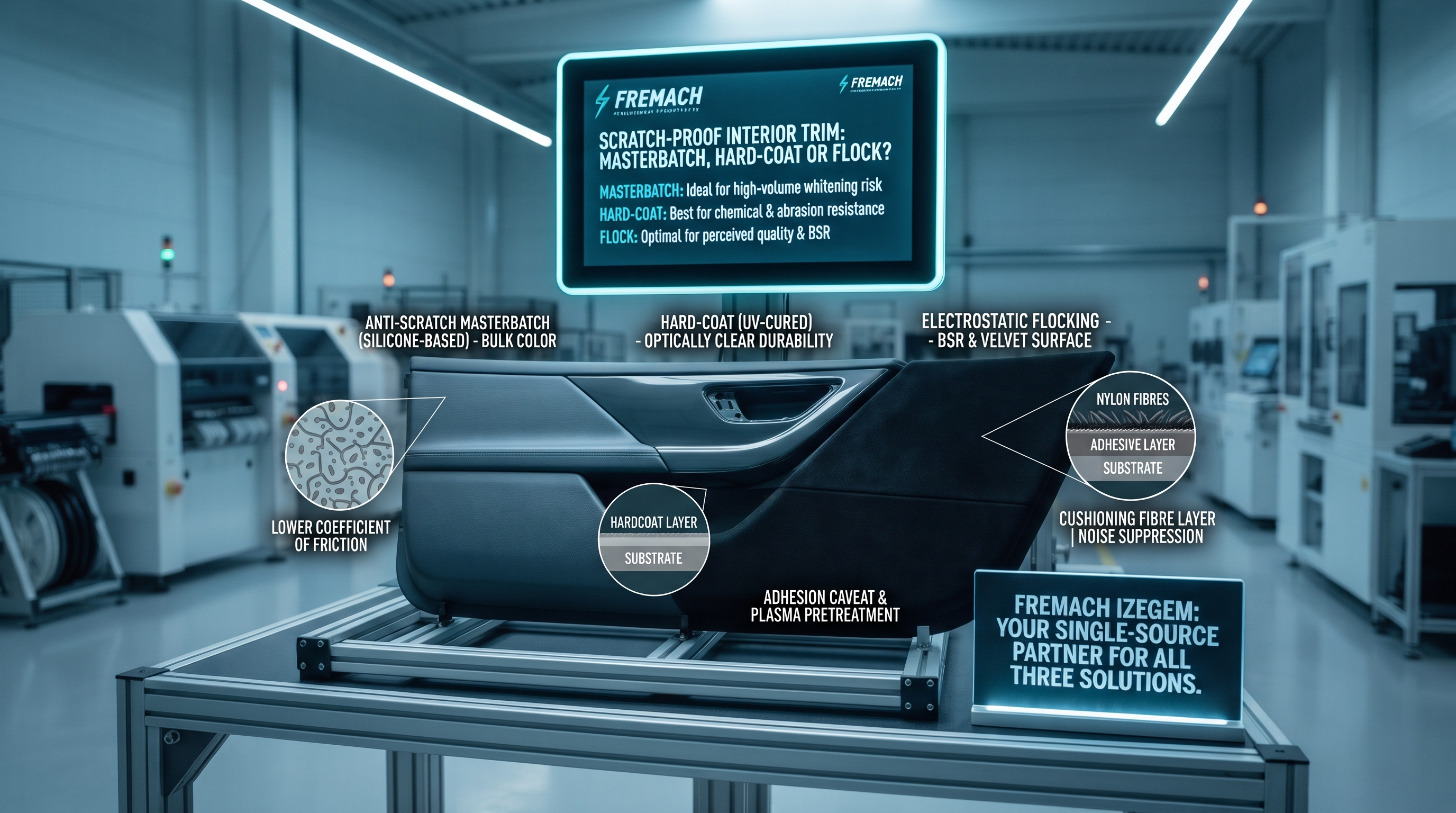
Interior trim now carries more visible surface than ever. Wide uninterrupted door panels, full-width instrument panels, and floating console bridges put moulded plastic directly in the occupant's eyeline and under their fingertips. At the same time, the recycled-content thermoplastics and talc-filled polypropylene increasingly specified on cost and sustainability grounds tend to whiten and mar more readily than the virgin compounds they replace. The predictable result is a rise in cosmetic field complaints set against tightening OEM scratch and mar limits (VW PV3952, GM GMW14688 and GMW14698, BMW GS97034, Ford FLTM BO 162-01, VDA 230-218).
There are three credible ways to engineer scratch resistance into a moulded interior part. They are not interchangeable. The right choice depends on the failure mode you are designing against, and getting it wrong surfaces late, at PPAP or in the field.
Anti-scratch masterbatch: protection in the pellet
Silicone-based anti-scratch masterbatch works inside the polymer rather than on top of it, lowering the coefficient of friction and masking damage through surface microtopography. On the instrumented ASTM D7027-20 scratch test, a baseline PP at a 100% visibility index drops to 30 to 40% at 1 to 3 wt% loading. The field correlation is real: a talc-filled PP dashboard compound retrofitted with silicone masterbatch returned a 3x improvement in whitening-load and a 60% reduction in cosmetic complaints. Grades exist that meet VW PV3952 and GM GMW14688 at 1.5% loading with ΔL below 1.5, in ultra-low-VOC, RoHS and REACH-compliant chemistries. Ultra-high-molecular-weight silicone systems give permanent, zero-migration performance at 2 to 3% and can remove the need for a secondary coat entirely on PP, TPO, PC/ABS and TPE.
The limit is honest: masterbatch reduces and masks scratch visibility, it does not eliminate the surface's vulnerability, and it adds no NVH benefit. It is the high-volume default for a visible Class A PP or TPO surface where the dominant risk is cosmetic whitening.
Hard-coat: hardness and chemistry, with an adhesion caveat
Where the surface must stay optically clear and survive high-force abrasion, a hard-coat wins on raw durability. A two-component thermally cured silicone hardcoat on polycarbonate showed no cracking, delamination or adhesion loss after five years of Florida and Arizona natural weathering, holding its optical properties to roughly 15 MJ/m² of Xenon-arc exposure. UV-cured systems tend to pass scratch requirements more consistently than thermal ones thanks to higher cross-link density (RadTech, 2012).
The caveat is adhesion. Interior plastics have low surface energy and are sensitive to heat and solvents, which makes them difficult to coat reliably; polyamide and polypropylene substrates generally need atmospheric plasma pretreatment before a UV coat will hold. Soft-touch coatings add a second tension: the softer, more velvety the feel, the lower the chemical and scratch resistance, yet an interior surface still has to resist DEET, suntan lotion, perspiration, grease and cleaners. VOC mandates are pushing solventborne 2K polyurethane toward waterborne and UV-cured dispersions, which is itself a sourcing consideration when you compare cure routes.
Flocking: removing the scratch surface altogether
The third approach changes the problem rather than hardening against it. Instead of resisting marring on a rigid polymer face, you replace that face with a fibre surface that does not fail the same way. A five-finger or grid scratch test grades a plastic surface for whitening, gloss change and marks; a flocked surface is assessed for fuzzing instead, because the failure physics is different. Dense nylon flock also forms a cushioning fibre layer, so between mating components it resists crushing and suppresses squeak and rattle, which is why flock is a standard BSR remedy. It dampens sound, delivers a suede-like perceived-quality lift, and conforms to difficult 3D geometry where a sprayed film would pool or a laminate could not wrap. The adhesives are water-based and low-VOC, formulated to meet OEM abrasion and climatic standards. Typical targets: glove boxes, console and armrest storage compartments, and door gaskets.
Choosing the route
The decision is cleaner than it looks. If the risk is cosmetic whitening on a visible PP or TPO surface at volume, specify masterbatch (integral, no secondary operation). If the part is transparent or glossy and faces high-force abrasion plus chemical attack, choose a hard-coat and budget for plasma pretreatment and a VOC-compliant cure. If the surface is touched, stored against, or mated to another component where scratch resistance, BSR and perceived quality converge, flock it.
At Fremach we are unusual in being able to put all three on the table for the same part. We injection-mould PP, TPO, PC/ABS and engineering plastics, can compound anti-scratch masterbatch directly into the part, finish and coat in-house, and run an automated electrostatic flocking line for complex 3D mouldings in Izegem. Because the tool and the surface decision sit under one roof, we can trial the alternatives on your actual geometry rather than a flat plaque. Send us the part drawing and we will flock samples on our line so you can feel and test the difference before you commit.