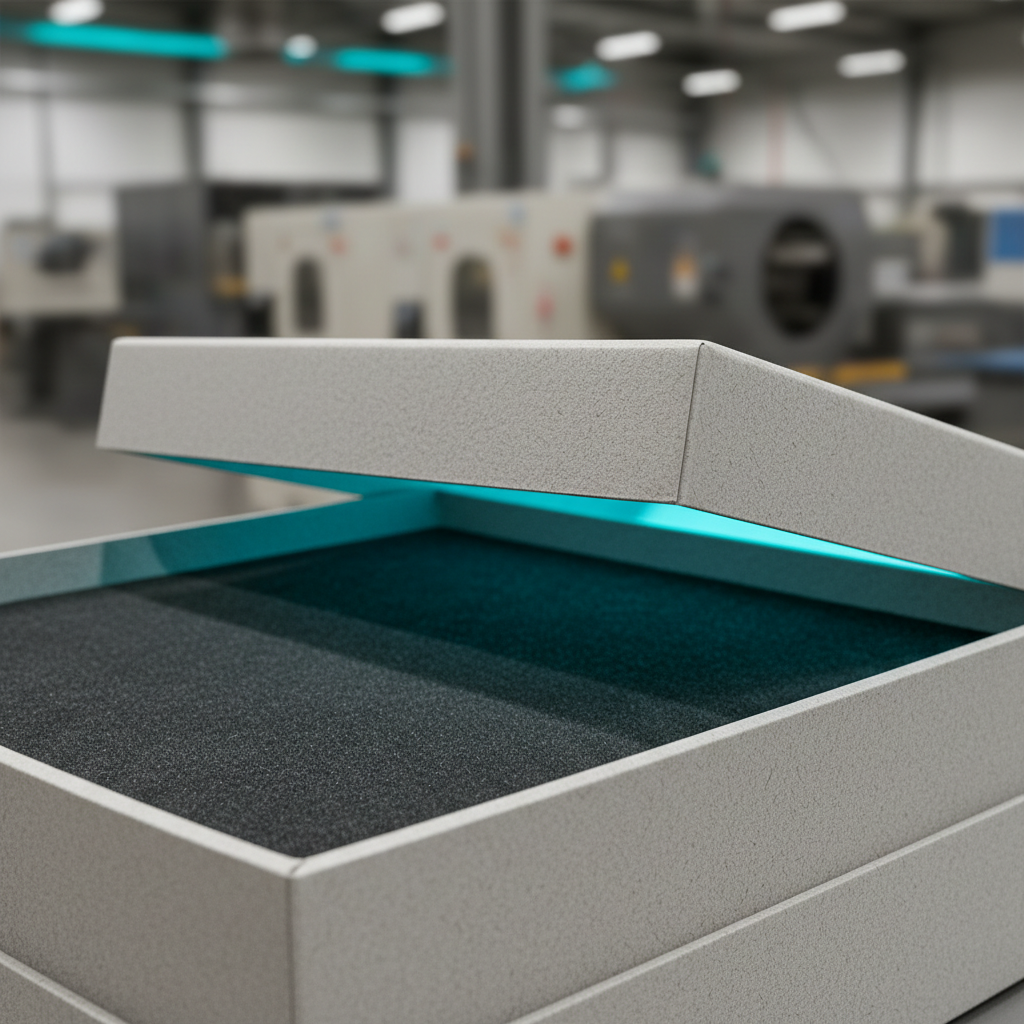
Think about the last time you opened something that felt expensive. Before you read a single word on the box, your hands already had an opinion. The weight of the lid, the way it lifted, the soft lining cradling the product inside: that is where a buyer quietly decides whether what they paid was worth it.
That soft, velvety lining has a name on our production floor. It is flocked. Millions of tiny fibres are stood upright across a surface to build a dense, suede-like finish that reads instantly as premium. For years, the easiest way to deliver that feel was a moulded plastic insert. It looked good, it protected the product, and it also turned an otherwise recyclable box into something a customer could not drop in the paper bin.
The feel people pay for is real, and measurable
This is not a matter of taste. Professor Mounia Ziat at Bentley University ran a controlled study across 36 packaging scenarios, varying colour, texture, and the way a box opened around identical chocolate samples. Raised, tactile textures made the product feel more indulgent, while smooth boxes felt ordinary. The single strongest factor in how much people valued the product, and how much they were willing to pay, was the unboxing interaction itself: how the box opened and unfolded in their hands. Those findings carry straight across cosmetics, electronics, jewellery, and luxury goods of every kind.
The inside of the box, in other words, is where the emotional peak happens. A flocked interior in a contrasting colour turns a routine open into something memorable, and increasingly into something people share.
The catch buyers can no longer ignore
The problem is what that experience used to cost in sustainability terms. A plastic tray glued or seated inside a paper box forces the customer to separate materials, and most never do. The whole package ends up in the wrong stream.
Buyers have caught on. Around 90% of consumers now favour recyclable, right-sized packaging, and roughly 82% say they would pay more for goods that are sustainably packaged. The sustainable packaging market is on track to pass three billion dollars globally in 2025. But there is a trap inside those numbers: only about half of consumers trust vague sustainability claims. A logo that says "eco-friendly" no longer earns belief. Recyclability has to be visible and genuine, something a person can see and feel rather than read.
That puts brand owners in a bind they know well. The velvet finish sells the product, but the plastic that delivers it undercuts the very sustainability story the brand wants to tell.
Replacing the plastic, keeping the velvet
The resolution is simpler than it sounds: apply the flocking to the paperboard itself, using natural cellulose fibres instead of synthetic ones. The result is an insert that feels every bit as silky and luxurious, can be dyed to any colour to match a brand, and goes into the same paper recycling stream as the box around it. No separation, no plastic, no compromise on the moment that matters.
This is not theoretical. A premium gift carton called the Flock Box, built around sustainably sourced paperboard from Holmen Iggesund, has already proven the principle: an embossed outer box with a fibre-flocked inner insert, fully recyclable through existing paper waste systems, aimed squarely at cosmetics, electronics, and jewellery. It is a clear signal of where premium packaging is heading in 2025, toward recycled paperboard bases and fibre-based flocking that protects the product in transit (reducing damage and returns) while protecting the brand's sustainability claim at the same time.
What flocking actually involves
The process is precise rather than mysterious. A fine adhesive is laid down on the surface, the fibres are given an electrostatic charge so they fly upward and embed standing on end, the adhesive is heat-cured to lock them in place, and excess fibre is vacuumed away. Done well, it produces an even, durable, genuinely velvety finish. Done at scale, it has to be consistent on every single unit, because one patchy insert undoes the whole impression.
Consistency at scale is exactly what we do. At Fremach in Izegem, automated electrostatic flocking is a core capability, and we apply it across a range of substrates, including paperboard and cardboard. That means we can help a brand keep the tactile luxury its customers respond to while moving away from the plastic insert that complicates recycling, all on equipment built for repeatable, high-volume production rather than one-off samples.
If you are rethinking the inside of your packaging, that is a conversation we would enjoy. Send us the product you want to cradle, and we will flock a sample insert on our line in Izegem so you can feel the difference for yourself, and check that it goes cleanly into the paper bin afterwards.