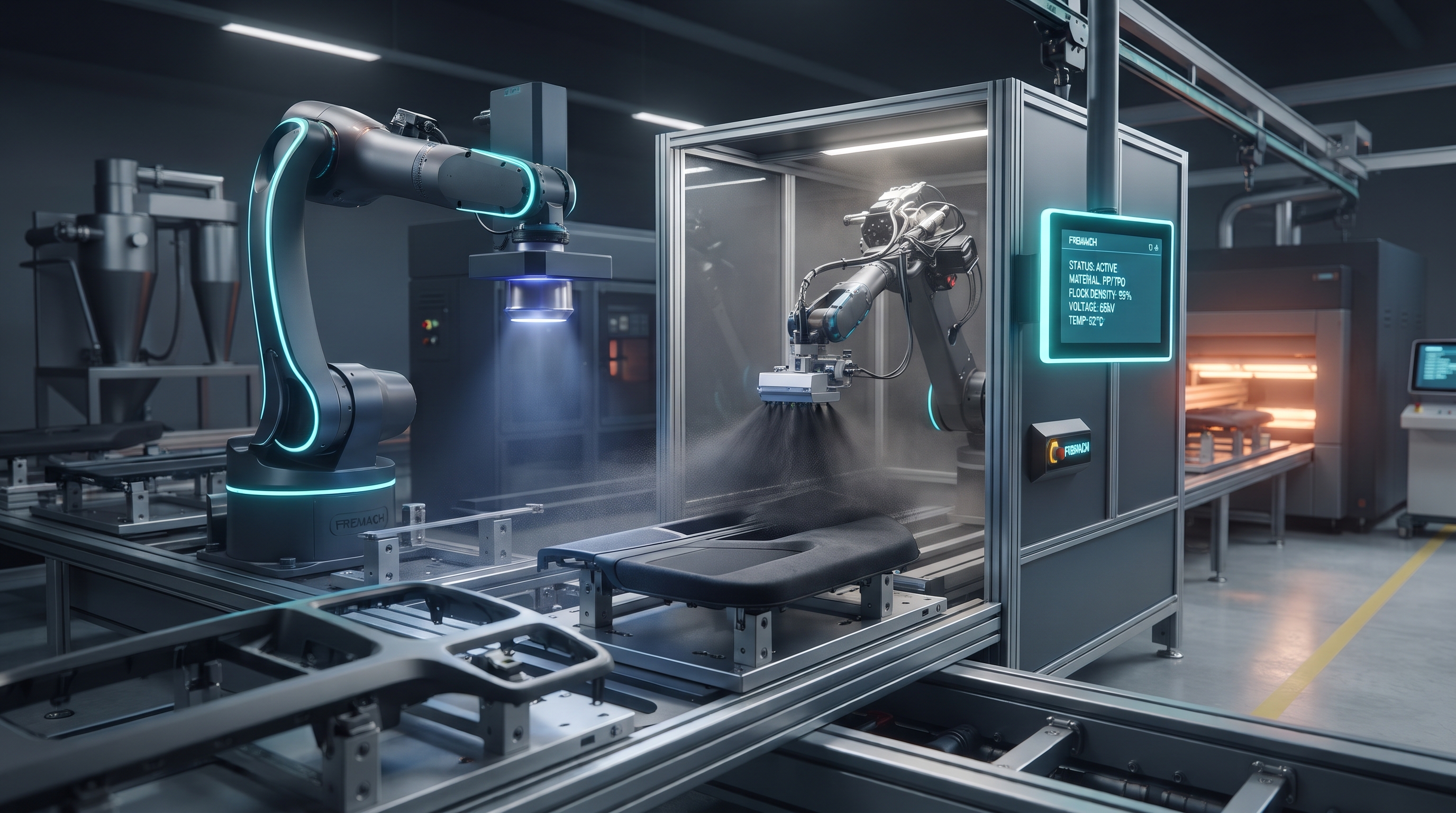
Polypropylene and the thermoplastic polyolefins (TPO) have become default choices for moulded parts across furniture, consumer goods, medical housings, and industrial enclosures. They are light, chemically resistant, recyclable, and inexpensive to process. The same chemistry that makes them attractive also makes them the hardest substrates to flock. Get the surface wrong and the flock layer lifts in service, however good the fibre or the application equipment. As more designers specify polyolefins for their recyclability and weight, this is a problem we are asked to solve more often, not less.
Why polyolefins resist adhesion
PP and TPO are non-polar materials with very low surface energy. Untreated, they sit around 20 to 32 dynes/cm. Most flock adhesives need a surface energy of 38 to 42 dynes/cm to wet properly. Below that threshold the adhesive beads up instead of spreading, much as water beads on a waxed panel. A polar adhesive simply cannot make intimate contact with a non-polar surface, so the bond starts to fail before it has properly formed.
There is a second, slower problem: migratory additives. Mould release agents, slip agents, and plasticisers migrate to the surface over time and build a weak boundary layer that blocks adhesive contact. This is why a part can test perfectly straight off the tool and then delaminate weeks later. Surface energy is not a one-time measurement; it is a moving target.
We judge every bond by how it fails. Adhesive (interfacial) failure, where the adhesive peels cleanly off the plastic, points to poor preparation or low surface energy. Cohesive failure, where the adhesive splits within itself, is acceptable. Substrate failure, where the plastic tears before the bond releases, is the result we design for.
Raising the surface energy
Three activation routes get a polyolefin above the wetting threshold, and each behaves differently.
Corona discharge ionises the air at the surface and lifts surface energy from the low 30s to around 58 to 60 dynes/cm. It is fast, but the effect has a short shelf life: the activated surface relaxes, so bonding has to follow soon after treatment.
Plasma activation reaches higher (60 dynes/cm and beyond, up to roughly 105 dynes/cm on TPO and TPU) and holds longer. A 2025 study published by the ACS measured interfacial fracture toughness of 152 to 405 N/m on plasma-treated polypropylene against 114 to 156 N/m for untreated controls: a step change in how hard the interface is to break.
Flame treatment uses controlled combustion to oxidise the surface. Work from the Sabreen Group shows flame-treated polypropylene is more highly oxidised, more wettable, and more stable than corona-treated PP, which carries a low-molecular-weight surface region prone to reorientation. Flame has a useful side effect: it smooths moulded nubs and burns off contaminants, and a 3D part can be treated in a single pass. A 2024 comparative study ranked effectiveness on HDPE as air plasma, then flame, then laser. The catch is over-treatment, which degrades the surface and causes its own adhesion failures, so dwell time, fuel-to-air ratio, and stand-off distance all have to be held tight.
Primers that bridge the gap
Activation is often paired with an adhesion promoter. Chlorinated polyolefin (CPO) primers work because their non-polar backbone keys into the polyolefin through Van der Waals forces while polar head groups (chlorine or maleic anhydride) couple to the adhesive. Typical practice is 5 to 10 percent solids at 0.1 to 0.2 mil dry film thickness with a few minutes of flash-off. Newer non-chlorinated chemistry is changing the economics: a 2024 study showed maleic-anhydride-grafted polypropylene (PP-g-MAH) primers performing at 0.5 to 1 percent concentration against 3 to 20 percent for CPO, less chlorine and far less primer per part for the same bond.
Why we mould and flock under one roof
Most of these failures are timing and contamination problems, and that is exactly what an integrated process controls. Because we injection-mould the part and run automated electrostatic flocking on the same site in Izegem, we manage the full chain. We can specify a substrate formulation that limits migratory additives, schedule surface activation immediately before flocking so a short-shelf-life treatment never has time to relax, and tune the adhesive's viscosity and conductivity for the electrostatic field so fibres land perpendicular in an even film. We verify the result the way the research does: dyne-pen checks on the activated surface, ASTM D903 peel testing, and environmental aging at 85°C and 85% relative humidity for 1000 hours, with thermal cycling from -40°C to +80°C for parts that will see it.
If you are evaluating a flocked finish on a polypropylene or TPO component and want to know whether it will still be bonded after a decade in service, the honest answer comes from a trial. We can run your part on our automated flocking line in Izegem and put the bond through the same tests we have described.