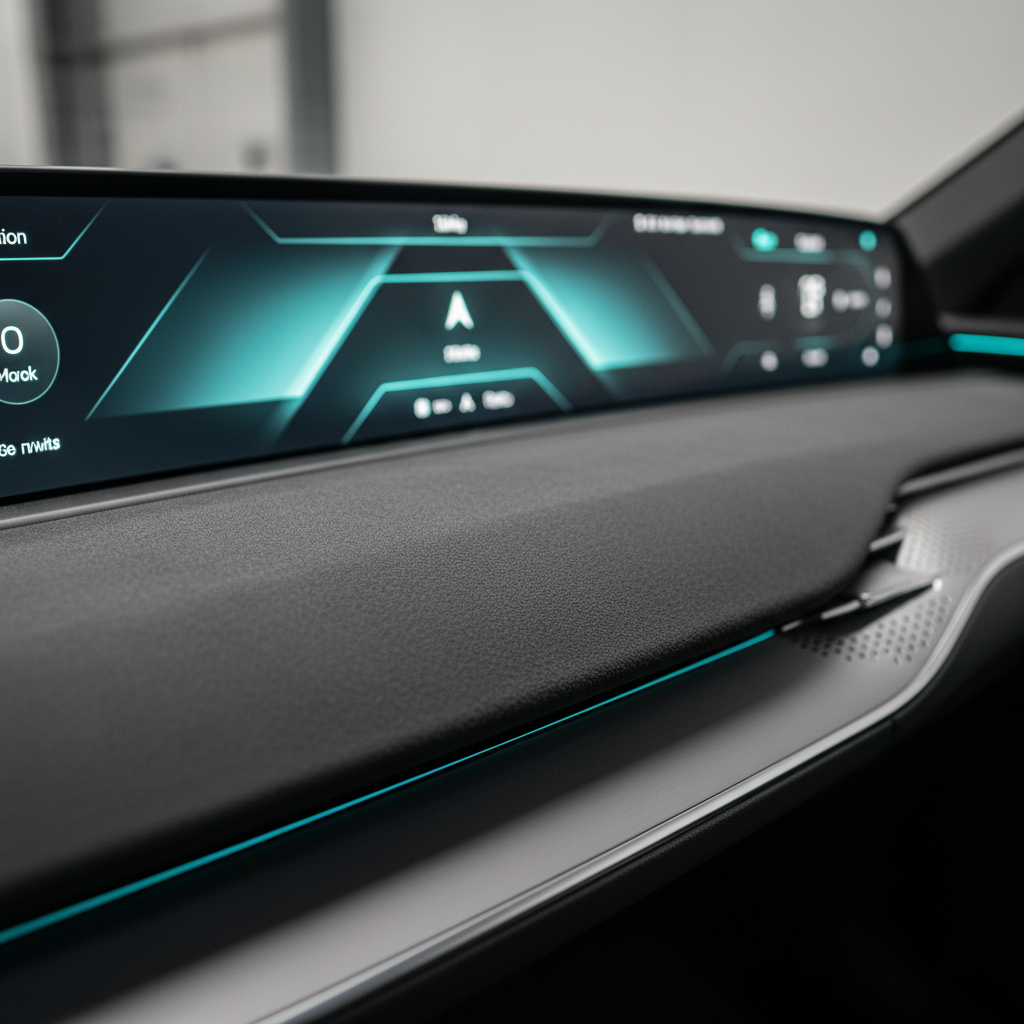
The upper instrument panel has always reflected light, but the cockpit around it has changed faster than the surface spec. Panoramic displays are now the centrepiece of the dashboard: the 2024 Lincoln Nautilus introduced a 48-inch panoramic screen, BMW has followed with a full-width system of its own, and at CES 2026 Tianma showed a 49.6-inch C-shaped display merging the cluster, centre and passenger zones into a single surface. Each screen sits behind and below an upper IP that, if it carries too much gloss, throws a reflection onto the display and up into the windshield. The surface that used to be a styling afterthought now sits in the driver's eyeline twice.
Gloss is a specification, not a finish preference
OEM materials engineers treat appearance the way they treat tensile strength or flammability: defined acceptance ranges, documented pass/fail criteria. Gloss is measured in gloss units against ASTM D523, with the measurement angle chosen to suit the finish (20 degrees for high gloss, 60 for mid-range, 85 for matte and low-gloss surfaces). For an upper IP, the relevant number sits at the matte end, and low-gloss interior specs typically call for under 10 GU at 85 degrees, with interior-plastic requirements traceable through standards such as SAE J1545 and ISO 2813. The difficulty is not hitting that number on a flat coupon. It is holding it uniformly across a large, compound-curved part where every change in surface angle changes how light leaves it.
Why the incumbent finishes keep losing the argument
Soft-touch coatings have carried much of this surface because they deliver leather-like haptics, but they are vulnerable where the upper IP lives: under direct sun and repeated thermal cycling, the same chemistry that feels good can chalk, gloss up, or degrade. The complaints are real and well documented in owner forums, where drivers describe dashboards mirrored across the windshield and resort to laying carpet on the IP because no aftermarket fix works. A matte fibre surface solves the problem at the source. Flocking replaces a specular plastic or coated face with millions of upright fibres that scatter incident light instead of returning it, which is exactly why it has long been the default for glove boxes and consoles.
The display and the driver-monitoring camera both depend on it
Two newer constraints have pulled this back onto the OEM agenda. First, the displays themselves: Peugeot deletes the top cap entirely on its Panoramic i-Cockpit specifically to protect contrast and black depth and to avoid reflections from upper IP surfaces onto the screen. Where the cap stays, its finish has to do that job instead. Second, driver and occupant monitoring: these cameras share the cockpit's optical path, and any glare or spectral interference along it reduces detection accuracy and raises false positives. A surface that bounces sunlight toward a DMS sensor is now a functional-safety concern, not only an aesthetic one, and that matters when the AAA Foundation has measured infotainment interactions distracting drivers for up to 40 seconds, far enough to cover half a mile at 50 mph.
What it actually takes to flock an upper IP
The physics are straightforward; the process window is not. Electrostatic flocking uses a high-voltage DC field to drive cut fibres (typically 0.25 to 5 mm) into an adhesive-coated substrate so they stand vertical and present an even, diffuse face. Fibre conductivity is sensitive enough that humidity and temperature swings can change it by a factor of three or four, so the application atmosphere has to be held tightly (around 60% relative humidity and 20 degrees C). On a complex 3D upper IP, fibre density and orientation must stay consistent as the geometry turns away from the field, because any patch of thin or laid-over flock reads immediately as a gloss variation and fails the spec. Done well, the same surface also damps NVH and resists UV and abrasion.
Where Fremach fits
This is a surface that rewards integration. We injection-mould the substrate and run automated electrostatic flocking under one roof in Izegem, which means the dimensional consistency of the part, the surface-energy and adhesion preparation, and the fibre density and orientation are all controlled in one process chain rather than handed across suppliers. For upper IP geometry, that control is what turns a low-gloss target into a low-gloss part: consistent flock laydown across compound curves is how you hold sub-10 GU uniformly rather than only on the easy faces. If you are evaluating low-gloss finishes for an upper IP or a display surround, we can flock representative parts on our line in Izegem and measure them against your gloss and durability targets before you commit to tooling.